

FicStack: Behind the Story #2
With Abhishek Banerjee


"I write from the places I'm most reluctant to examine myself."
That's how Abhishek Banerjee describes his process, and it shows. His fiction sits in the uncomfortable gap between what people feel and what they're willing to name.
We're glad to have him in this edition of Behind the Story.
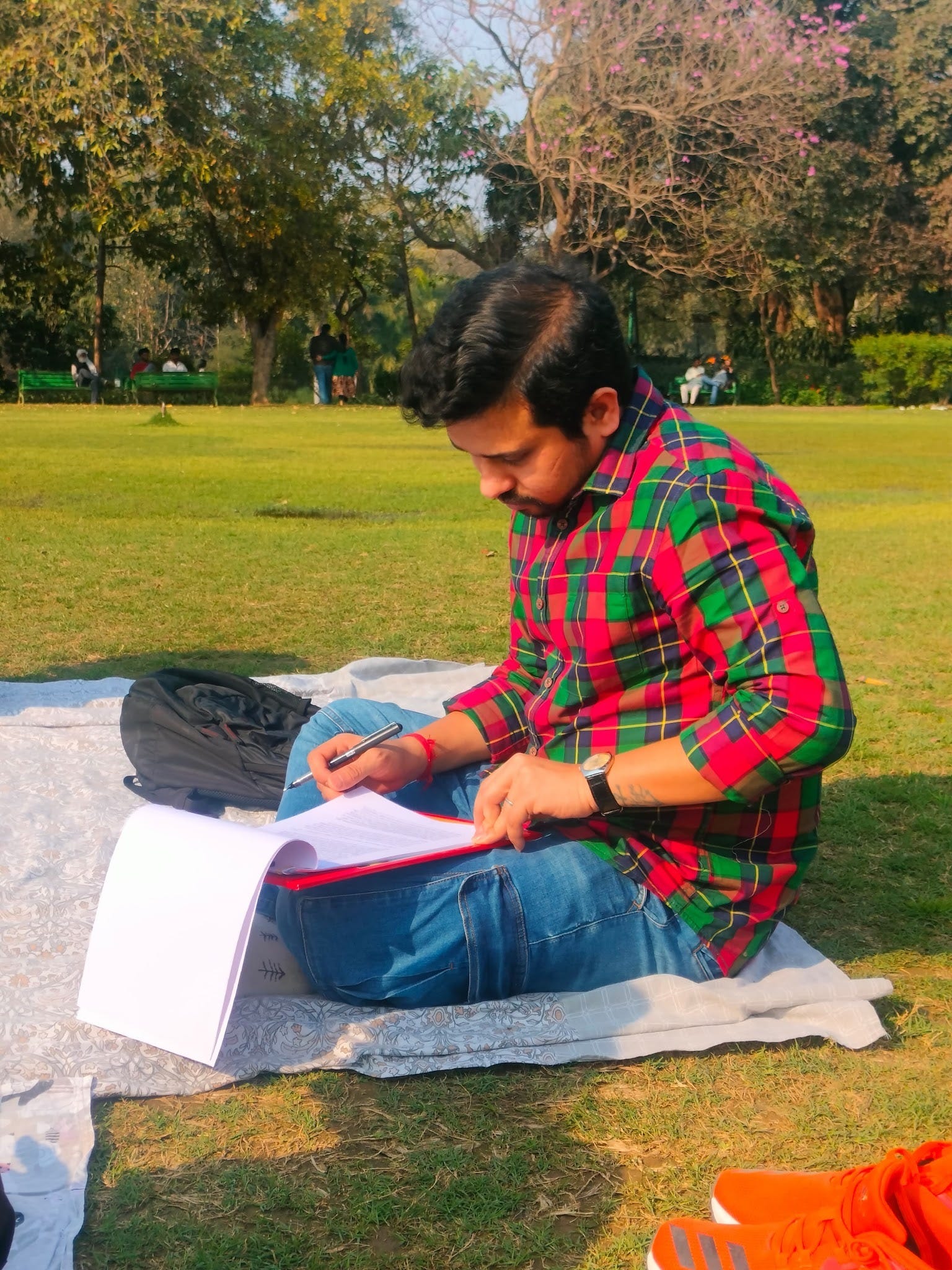
Tell us about yourself! Where are you from? What do you do for fun? What might people be surprised to learn about you?
I’m Abhishek Banerjee. I’m from Delhi, India, and I’ve been writing since I was twelve. In diaries, mostly. Not because someone encouraged it or because I had some early sense of destiny. I had nowhere else to put what I felt, and the world didn’t seem particularly interested in receiving it any other way.
That hasn’t changed much.
I write fiction on Substack now, but the root is still those diary pages. I’m a deeply internal person. I absorb things. News, loss, other people’s pain, things happening on the other side of the world that have no direct connection to my life but sit in my chest for weeks anyway. I’ve also known grief very closely and personally, the kind that doesn’t become a lesson. It just becomes part of how you see everything from that point on.
For fun? I read obsessively. I run book club discussions, which is really just finding people willing to argue about fiction with me. I go to the gym most mornings. And I write, always, because that is not a hobby for me. It never was.
What might surprise people is that I have 169 subscribers. I know that number. I’m genuinely, quietly grateful for each of those 169 people in a way that has nothing to do with growth or reach. But I didn’t start writing for them and I don’t write for them now. I write because I have no honest alternative. If that number never moves, I’ll still be here on a Tuesday night finishing something I’m not sure anyone wants to read, because I need to write it.
I believe in God, but privately, not performatively. I’ve never been afraid of the darker or greyer parts of myself on the page. My intent is known. That’s always been enough for me.
We’ve featured both The Forgetting Place and The Development.
What sparked these stories? Was there a specific image, moment, or question that started them?
The Forgetting Place came from something I know in my body, not just my mind. The exhaustion of memory. Not the romantic, elegiac kind. The grinding kind where things that happened years ago still feel like they happened this morning and you start to seriously wonder what it would feel like to just stop. To not carry it anymore.
The story gave that feeling a location or a map. A hill town in Uttarakhand, too remote to be found easily, water that slowly dissolves what you remember, a man broken enough to find that seductive rather than terrifying. I didn’t have to imagine that man from scratch.
The Development was written for a micro fiction challenge set in a world where Purgatory exists in the suburbs. What I was actually writing about was the damnation inside ordinary life. The acceptable losses. The convenient beliefs. The love you called sufficient because admitting otherwise would have cost too much. Elena’s looping street, her dog that never ages, the sprinklers running at 3 AM. None of that is punishment from outside. It’s the architecture of what she already chose and refused to examine.
What were you exploring or working through in these pieces? What questions were you asking?
Both stories are about memory and accountability and how desperately we want to be released from both.
In The Forgetting Place, the real horror isn’t the pharmaceutical company or the contaminated water. It’s how quickly the narrator starts to prefer the erasure. That preference is the most uncomfortable thing in the story, and the most true, because I think most people have felt some version of it. The wish to just put down the weight of who you were and walk away lighter.
In The Development, Elena isn’t being punished for what she did. She’s being punished for what she chose to believe about the life she built. That felt like an important distinction to me. We’re most complicit not in our worst moments but in our quiet ones, when something painful is right in front of us and we decide to look away.
I write from the places I’m most reluctant to examine myself. It’s not bravery. It’s just the only kind of writing that feels worth the time.
Is there a line or moment you are particularly proud of?
From The Development: “She is not being punished for what she did. She is being punished for what she chose to believe about the life she built here, the acceptable losses, the negotiated silences, the love she called sufficient.”
That sentence happened and I knew the story was finished. In under 300 words, it had to hold the entire moral weight of the piece. I think it does. And I think it’ll land differently for different readers depending on what they themselves have chosen to believe about their own lives.
From The Forgetting Place, the narrator’s journal entry written to his own future amnesiac self is where the story turns from personal to something larger. “If we all forget, they win. And the Forgetting Place won’t be a town anymore. It’ll be the whole world.” That escalation felt earned because the intimacy came first.
What do you hope readers take away from these stories?
Not comfort. I’m not in the business of comfort.
I want that specific, slightly unsettling feeling of recognition. Reading something and thinking: I’ve never seen this written down before, but I’ve lived with it. The weight of a life you’ve quietly settled for. The relief you feel, and then hate yourself for feeling, when you stop remembering something that hurt you.
If someone closes either of these stories feeling slightly implicated in themselves, in their own silences, in their own negotiated blindness, then the story did exactly what it was meant to do.
How do these fit into your larger body of work?
I keep coming back to the same territory. The interior life of ordinary people under quiet, extraordinary pressure. The catastrophes that never make it into conversation. Quiet Lives, my Substack, exists entirely for that, standalone fiction about human emotion and all the things people feel but aren’t normally willing to name out loud. These two stories belong there completely, even when one of them is set in Purgatory. The metaphysics change. The emotional space or design doesn’t.
What does your writing process look like? Do you outline, or discover as you write?
I’ve been writing in diaries since I was twelve. That never stopped. It just changed shape.
Fiction, for me, is still diary writing at its core. I don’t begin with plot or structure. I begin with pressure. A feeling I can’t resolve, a question I keep circling, something that refuses to leave. The structure comes later, almost as scaffolding for the emotion rather than the other way around.
I rewrote a lot, not to improve things technically but to find what the story was actually trying to say. The first draft is almost always me figuring out the real subject. The revision is where I have to face it.
What are you working on now? Anything readers can look forward to?
Several things at once, because I find it hard to stay in one emotional register for too long. The Dendrochronology of Us, a flash serial set in a small town in Japan, about love across a twenty year age gap, using tree ring dating as a metaphor for a relationship’s thin and wide years. My political fiction series forty one and the maintenance of absence, which lost me some subscribers and got me the readers I actually wanted. That felt like an honest trade.
What has fiction writing given you that you couldn’t find any other way?
A place to put the things that have no place.
I absorb grief in a way that can become unmanageable. My own and what I see in the world. I’ve known loss closely enough to know it doesn’t resolve into wisdom on any reliable schedule. Writing hasn’t fixed any of that. But it has made it liveable. There’s a difference between surviving something and having somewhere to put it. Writing is where I put it. That’s not a small thing. For me it’s been everything.
Why did you choose Substack for your fiction?
I didn’t choose it strategically. I stumbled in through the most beautiful person Kritika whom I am married to, in August 2025, with nothing planned and no expectations. But I stayed because Substack gives fiction writers something genuinely rare. Readers who chose to be there. No algorithm deciding who sees what. If someone reads your story, they came for it. That changes the quality of the silence between a writer and a reader. It starts to feel something like trust.
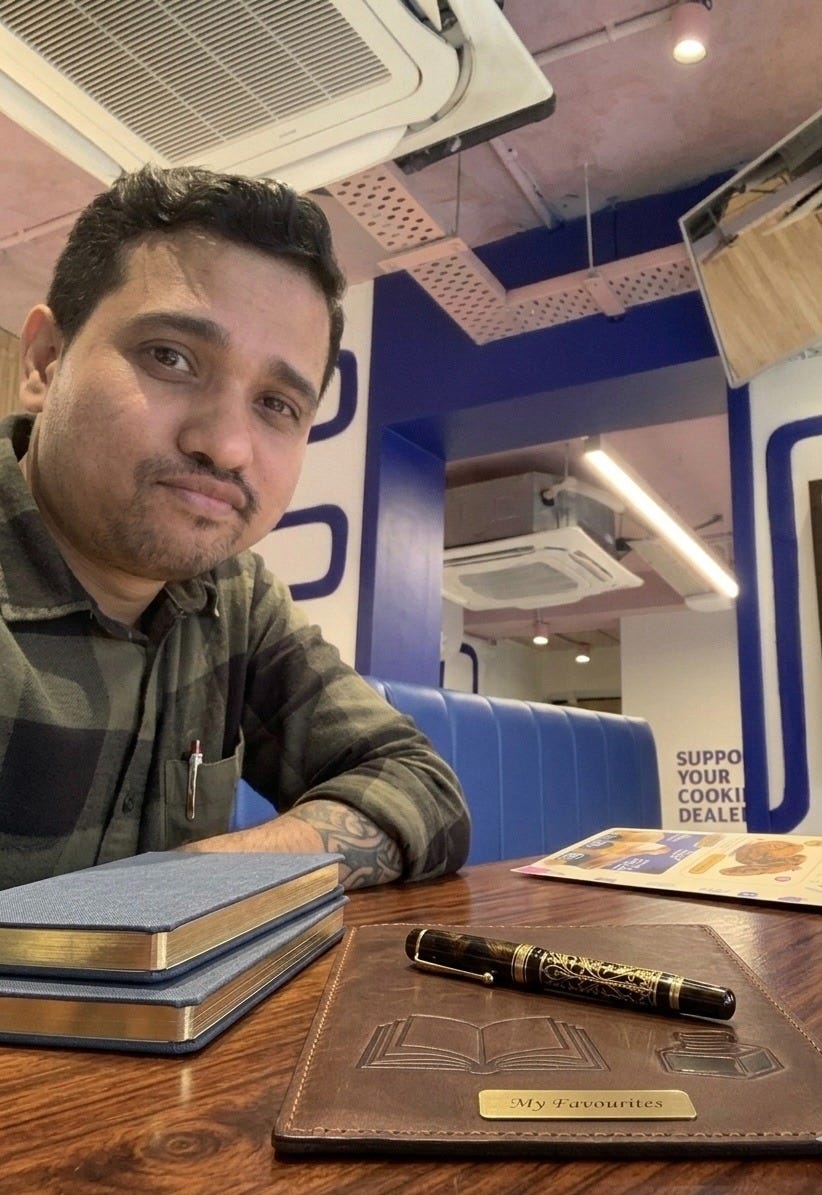
What’s one piece of advice you’d give to emerging fiction writers?
Write the story only you could write. Not the one you think will land well. Not the one that fits what’s working right now. The one that makes you slightly uneasy because it’s too specific, too interior, too uncomfortably yours. True to your heart!
The writers who have stayed with me are the ones who seemed incapable of writing any other way. That incapability is not a flaw. That’s the entire point.
What can you recommend to our community?
Read Fredrik Backman, but in sequence and without rushing. Beartown is the wound that doesn’t close, Backman with the sentimentality scraped away, his most unforgiving and literary work. Every Morning the Way Home Gets Longer and Longer is eighty pages of surgery. Read it in one sitting and don’t make plans afterward. Anxious People is structurally unhinged in the best way, the book where he seems to be genuinely enjoying himself, which somehow makes it the one that hits hardest.
On Substack, find the writers who write like they have no choice. You can always feel the difference between someone writing for an audience and someone writing because not writing is worse. Follow the second kind. They’re the ones who’ll stay with you.
My favourites ones - Bradley Ramsey, Mina Howell, Maryellen Brady, Rafa Joseph, Storm Whisperer and Asuka Hotaru to name a few.
Discover Abhishek Banerjee on Substack.
Featured stories: The Forgetting Place & The Development.
 | A guest post by
|
 | A guest post by
|
 | A guest post by
|
 | A guest post by
|
 | A guest post by
|
Beautiful piece of reading, Abhishek :))
Oh I love this series! This is so cool!